
/59748.tmb-300v.png?sfvrsn=9885965b_2 "For the future - publication thumbnail")
/rc77-branding-final-layered.psd-(3).tmb-1920v.png?sfvrsn=6814d0d1_1)
#RC77
WHO
©
Credits
Welcome to the #RC77 social media toolkit!
This toolkit is designed to help delegates, partners and health leaders amplify the key priorities of the seventy-seventh session of the WHO Regional Committee for the Western Pacific. Bookmark this page!
Use your social media channels to:
- Share a personal story related to the key topics of #RC77 – including AI for health; hypertension; immunization; and tobacco control.
- Share your excitement or reflect on your experiences at #RC77 or previous Regional Committees – don’t forget to use the hashtag so we can follow along! Tag @whowpro and any other relevant accounts you wish.
- Help share information about the key topics being addressed at #RC77.
- Advocate for tobacco control in your countries with MPOWER .
- Call for climate action to support health system safety and resilience.
- Share knowledge and advocate for hypertension control policies.
- Tell us about AI and health in your context – especially AI-powered solutions that improve health and make it more accessible.
- Keep the conversation going about immunization and what we need to sustain progress in the Western Pacific Region.
Social media essentials
Artificial Intelligence
Key messages
- Artificial intelligence is reshaping health care, public health and decision-making. It has the potential to transform health care systems and people’s access to health and care across the Western Pacific Region
- AI adoption should start with national health challenges, not with available technologies. Governments must identify and prioritize AI use cases that address pressing health needs, improve access to care and deliver measurable public value, especially for underserved populations.
- Successful AI implementation depends on more than technology. Countries need risk-proportionate governance, secure data systems, validation mechanisms, sustainable financing and skilled institutions to ensure AI is safe, effective and accountable.
- Regional collaboration can accelerate the responsible adoption of AI. WHO is working with countries and partners to create practical guidance, technical assistance and more to help countries learn from one another and harness the power of AI to strengthen health systems.
- WHO is supporting countries to help shape the role of AI in public health and ensure safe and responsible adoption of AI through the Guidance for Responsible AI in Health in the Western Pacific Region to help deliver better health and well-being for people tomorrow.
Food for thought
The report identifies the ethical challenges and risks with the use of artificial intelligence of health, six consensus principles to ensure AI works to...

Immunization
Key messages
- Immunization is one of our most effective investments in health, yet progress in the Western Pacific is slipping, mirroring a pattern seen in other WHO Regions as well.
- We need to reach every child. Reaching zero-dose and under-immunized children is a measure of whether health systems are truly leaving no one behind. Governments can close immunity gaps by strengthening routine immunization, using better data to identify missed populations, investing in health workers and last-mile delivery, and bringing vaccination services closer to underserved communities.
- Measles – one of the most contagious diseases - anywhere can ultimately put communities everywhere at risk. Despite progress made in many countries and areas, the Western Pacific is at risk of missing its overall 2030 measles elimination target. Achieving elimination requires sustained national financing, at least 95% coverage with the second measles-containing vaccine dose, strong surveillance and rapid outbreak response, alongside regional solidarity and cross-border collaboration.
- The benefits of vaccination should extend from childhood through adolescence, adulthood and older age. As populations and health needs change, countries can progressively expand life-course immunization while protecting strong childhood programmes. Sustainable financing, evidence-informed policy, reliable vaccine supplies, stronger data systems and vaccine confidence will be critical to progress.
- WHO is working with countries to turn evidence into action, strengthen surveillance, data and supply systems, build confidence and reach those who have been missed.
/countries/papua-new-guinea/polio-in-papua-new-guinea-thumbnail.tmb-549v.png?sfvrsn=afb739a_1)
Hypertension Control
Key messages
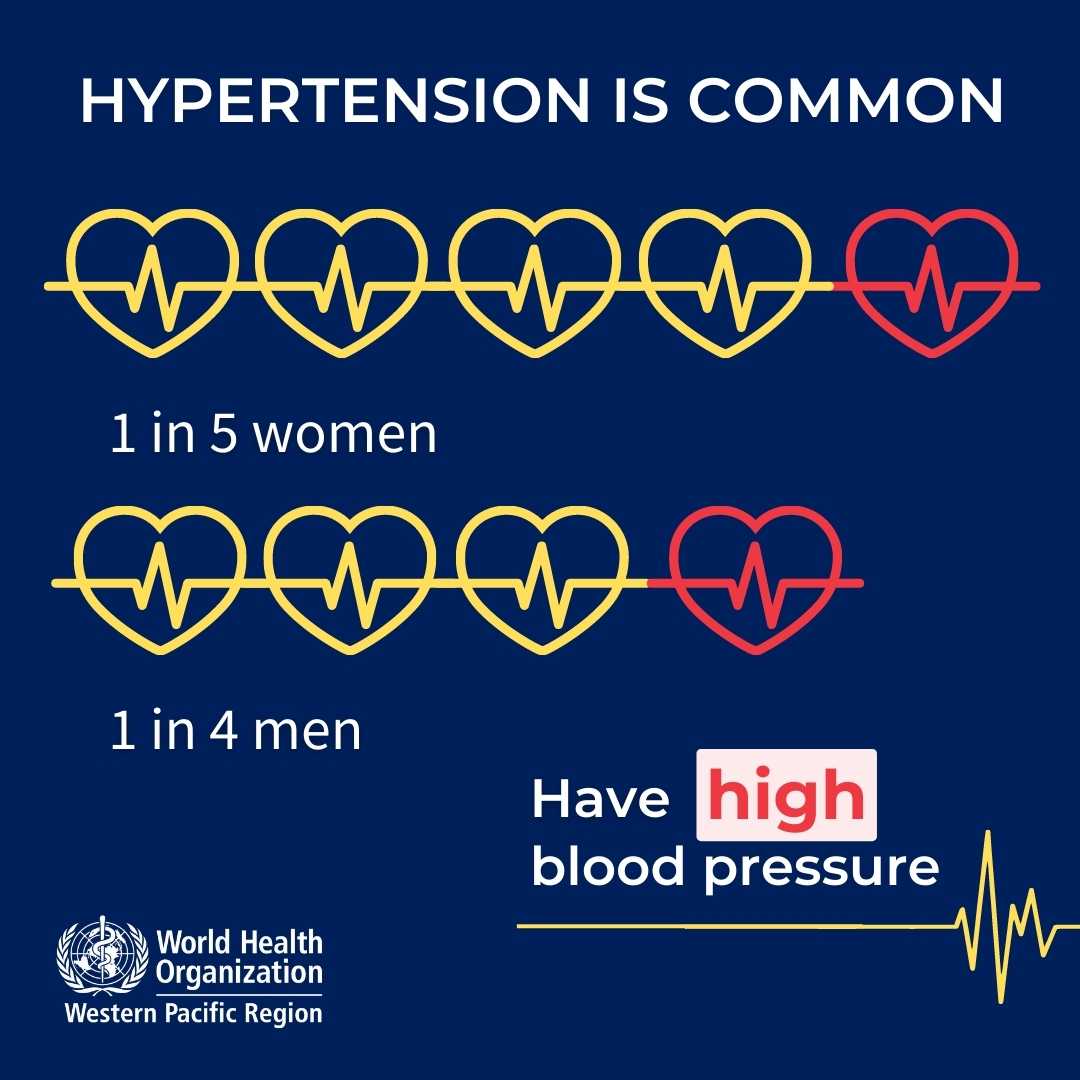
- Hypertension is the Region’s most urgent, silent threat. 1 in 3 adults live with hypertension in the Western Pacific Region. The Region has set an ambitious goal: 100 million additional people with controlled hypertension by 2029.
- Interventions are cost-effective and high-impact. Early management of hypertension can prevent needless suffering – extending lifespans and improving quality of life. It can also help prevent financial hardship for individuals and their families.
- Reaching the 80-80-80 targets by 2030 requires sustained political commitment and strong
- 80% of people living with hypertension diagnosed
- 80% receiving treatment
- 80% of those treated achieving blood pressure control
- Achieving the 80-80-80 targets needs a strong primary health care foundation to integrate care into the life-course and bring diagnosis, treatment and follow-ups closer to the communities that need them most.
- Controlling hypertension requires more than simple diagnosis. Access to affordable medicines and equipment, supportive care and quality data systems to improve outcomes are needed.
- Across the Western Pacific, WHO continues to support Member States to reduce hypertension - developing and implementing national policies, strengthening protocols and workforce capacity and promoting access to up-to-date interventions and solutions.
Tobacco Control
Key messages
- Tobacco remains a leading public health threat, causing an estimated 3 million deaths annually in the Region. Countries must urgently accelerate implementation of tobacco control measures to protect health and sustain progress.
- Countries need sustained political commitment, stronger multisectoral coordination and leadership beyond the health sector. Protecting public health policies from tobacco and related industry interference is equally vital, with WHO FCTC Article 5.3 institutionalized across all ministries, not just health.
- High impact interventions like taxation measures deliver rapid public health gains.
- Countries must ban or strictly regulate new and emerging tobacco and nicotine products, such as e-cigarettes, heated tobacco products and nicotine pouches. Strong enforcement and future-proof regulatory frameworks are essential to prevent youth uptake, nicotine addiction and the renormalization of tobacco use.
- WHO will support Member States to accelerate tobacco control through high-level advocacy, stronger leadership and governance, technical guidance on taxation and regulation, action to counter industry interference, and greater regional collaboration.
